Small tokens, big stories

Few symbols evoke emotion more deeply than the emblems of commemoration. A sprig of rosemary or the image of the rising sun, known for their appearance on the uniforms of soldiers, have the power to resurface old memories of those who served, and immense gratitude for those commemorating that service.
At ceremonies like the Dawn Service on the grounds of the Shrine of Remembrance, it’s common to see these images among the crowd of 50,000 all gathered to honour the brave Australians who served, and continue to serve, their country.
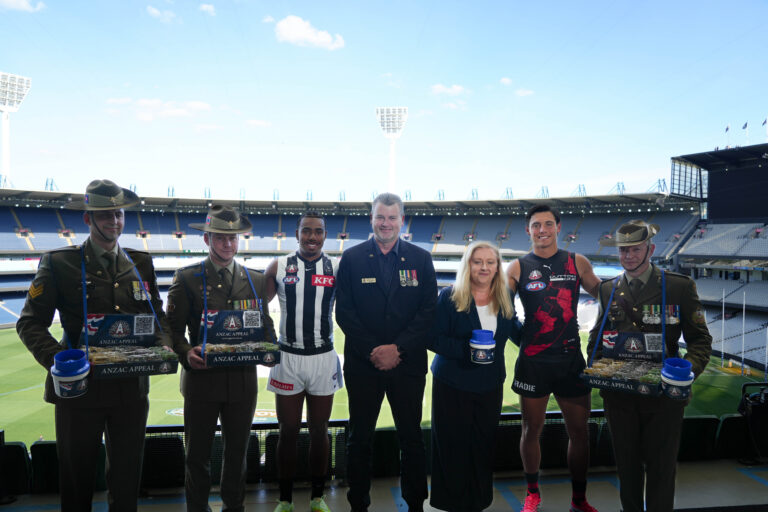
Badges have long been a feature of the RSL’s annual ANZAC Appeal, with each symbol hand-selected to recognise different conflicts, different battles, and different people who gave outstanding service to their country.
During the ANZAC Appeal, these symbols are given extra life and meaning, particularly on ANZAC Day, for those who wish to honour sacrifice and to give back.
Why badges?
RSL Victoria Fundraising Manager Peter Smith said the first fundraising appeals began following World War I. At that point, poppies were sold due to their connection to service and sacrifice.
“There were poppies, or paper images and cutouts of poppies, sold in Victoria to support schools that were demolished in France on the Western Front of World War I,” he said. “That then grew into what we now know as the Poppy Appeal. That was the first selling of something to raise money for our cause.”
Badges similar to the ones we now know and love were created to embody the elements of the uniforms the soldiers wore. “Today we still use the same symbolism,” Peter said. “We use it in [RSL’s] trademark, our logo, we use it in some of the badges, but over the journey we’ve added other badges, other symbols, other images to create and tell a story of military service and sacrifice.”
These same badges displayed proudly at ANZAC Day services around the state help to provide invaluable funds for veterans and their families through the ANZAC Appeal. “If people are going to have a symbol of their participation in commemoration, it may as well be one that has a beneficial effect for veterans and their welfare,” Peter said. “It’s a nice thing to do to buy a badge and wear it with pride during commemoration but also be comfortable in the knowledge that it’s helping to raise money for veterans.”

The slouch hat
The origins of the hat khaki fur felt, or ‘slouch hat’ as it’s more commonly known, date back further than what is probably realised. The wide-brimmed bush hat turned up on the left-hand side was first used by the Victorian Mounted Rifles in the 1880s and 1890s and became standard issue by the early 1900s.
Military Historian Dr Adrian Threlfall has spent years researching the service and sacrifice of our soldiers across global conflicts spanning centuries. He said the slouch hat was arguably one of the most recognisable symbols of service in Australia.
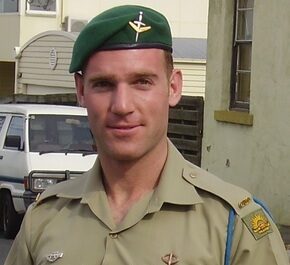
“You would all turn up your brim and that’s where the Rising Sun badge would be seen,” Dr Threlfall said. “It’s so when you shoulder arms, when you put your rifle on your left-hand shoulder to march or to parade, you don’t knock your hat off. Australian soldiers have worn a slouch hat since 1903.”
Between 1890 and 1903, Victorian and Tasmanian soldiers would turn the right-hand side of the hat up, and the rest of the states opted for the left-hand side. Between 1903 and 1905, the left-hand side was standardised around the country. It is now the symbol most synonymous with the Australian Army.
“It’s instantly recognisable worldwide I would argue,” Dr Threlfall said. “Particularly if you see the brim up, people recognise you instantly as an Australian soldier and I have no doubt that is one of the main reasons it has appeared on badges and in fundraising campaigns for decades.”

Rosemary
Rosemary was first adopted as a symbol of remembrance more than 2,000 years ago. “The Ancient Greeks and Ancient Romans believed that rosemary actually would help with the memory,” Dr Threlfall said.
“If you went to an exam or testing for students, they’d wear a sprig of rosemary in their hair or on their togas, because it would supposedly help them to remember when they went into those exams. It’s also a symbol of fidelity and a symbol of remembrance.”
Now, it is arguably one of our most common symbols synonymous with commemoration and ANZAC Day, previously referred to as ‘rosemary for remembrance’.
Rosemary was traditionally worn on Remembrance Day before the red poppy became the traditional emblem in the 1920s. In lieu of rosemary, people would wear a white or gold letter A, a symbol that held much prestige.
“Originally that meant that the wearer had landed at Gallipoli on ANZAC Day,” Dr Threlfall said. “By about 1917 the Australian authorities authorised those few originals who were still serving in the Australian Army, on the Western Front by then, that they could wear the letter A on their unit colour patches… so it was a pretty prestigious thing to do.”
The rising sun
Some know it as the General Service badge, others know it as the Australian Army badge, but it’s widely known as the Rising Sun badge. There have been many iterations of the Rising Sun badge, the first featuring a line of swords and bayonets positioned in a semicircle.
Modern versions of this badge feature only bayonets pointing upwards, emanating rays of the sun. It’s this feature, the replication of the sun, that has remained consistent over seven different versions of this particular badge.

Dog and handler
As much as we honour people who served, the impact of the animal heroes in global conflicts has also been etched in history. The dog and handler badge, featuring a man and his dog, pays tribute to not only the dogs, but all the animals that served as loyal comrades to soldiers on the battlefront.
Dr Threlfall said dogs particularly have been an invaluable resource in warfare for about a century. In recent conflicts in places like Afghanistan and Iraq, dogs accompanied sappers, or combat engineers, to detect improvised explosive devices (IEDs).
“Dogs have 130,000 times better olfactory senses, or better noses, than you or I do,” Dr Threlfall said. “The bomb dogs, or sniffer dogs, were very common.”
In much earlier conflicts, dogs were used to carry messages, and even first-aid kits, through trenches. “People probably see dogs with jackets on them to keep them warm in winter, and you’ve got seeing eye dogs and dogs at the airport with little vests on,” Dr Threlfall said.
“Back in World War I they had similar vests, but they carried first-aid supplies.” This badge honours the relationship between dog and human, symbolising reciprocal loyalty and bravery.
September 1945. Private Arthur Charlton of Canberra, ACT, points to where the Rising Sun badge used to be on his original slouch hat. He was a prisoner of war (POW) for three and a half years, and asked where the badge had gone he said, “A man gets very hungry in these POW camps and the Japanese like souvenirs. For a badge you could get a small bowl of rice to keep you going for a while.”
Mateship
The power of mateship has been recognised and celebrated through many global conflicts, and one that is immortalised in many ANZAC Appeal badges. The special edition Bull Allen badge features the brave stretcher bearer, Corporal Leslie ‘Bull’ Allen, who carried dozens of Australian and American soldiers to safety, putting his own life at risk to do so. The tri-service badge shows three arms of service, united by the cause of duty to country.
Dr Threlfall said mateship has been embodied in many art forms. “The idea of mateship is in John Schumann’s song I Was Only 19 with the line, ‘But you wouldn’t let your mates down ‘til they had you dusted off’,” he said.
“It’s that sort of sentiment that those you are serving alongside, you would do anything for them, and they would do anything for you because, ultimately, that’s who you have to rely on. People say when you’re in the military you’re fighting for your country or you’re fighting for the cause, but ultimately you’re fighting for the people serving alongside you.”

Show your support
The ANZAC Appeal provides life-changing support for veterans and their families. Proceeds from badge sales allow RSL Victoria to continue to provide this support to the veteran community in Victoria. Show your support by donating online or buying a badge and wearing it with pride.
Additional photography by Meg Gannon.
This story was originally published in the April 2025 edition of Mufti.