110 years on – the birth of RSL Victoria – Australia’s oldest veteran charity
In late August 1915 the last Australian offensive operations were being fought out on Hill 60 at Gallipoli. Having been cut down in their hundreds at Lone Pine at the beginning of August this last push advanced their position only marginally at a great loss of life. With the northern summer ending the attempt to capture the Dardanelles was doomed.
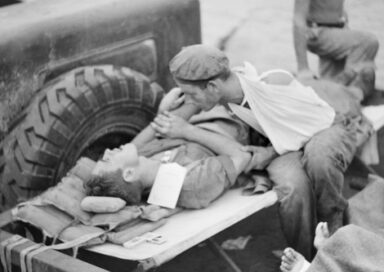
As Gallipoli was reduced to an unwinnable deadlock a group of men on the other side of the world were arriving home. They had escaped, albeit wounded, from the carnage at Gallipoli to what they thought would be a grateful nation. Instead, when the troopship Ballarat arrived home with one of the first boatloads of wounded soldiers no one was there to meet them.
Having suffered through the death and devastation of the trenches the lack of a reception shocked them. If their initial arrival was disappointing the homecoming receptions that were finally arranged must have been surreal for men just returned home from the horrors of the front line.
According to the Australasian magazine a welcome home party was put on by the chairwoman of the Overseas Club, which was itself a charity established to raise money for the war effort.
50 wounded soldiers from the Gallipoli campaign were invited and were “liberally supplied with cigarettes” provided by the Lady Mayoress’s Patriotic League. They were given a badge in the form of a large gum leaf bearing the word “Bravo” and a kookaburra in gold paint was pinned to their tunic with red, white and blue ribbons.
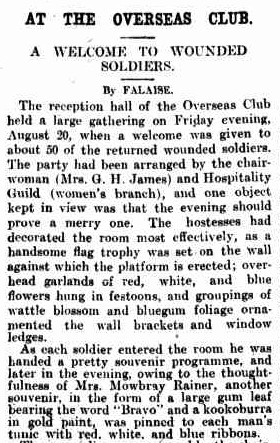
Streamers were thrown and patriotic songs sung at the wounded soldiers. Among those present was a Corporal James who had been shot through the spine and was “unable to hold himself erect.” Despite speaking of his determination to return to the front “and have another shot at the Turk” soldiers like Corporal James needed more than pretty ribbons and souvenirs.
While charities in support of the war had sprung up across the country the returned soldiers saw at once the need for a group to represent them. They needed an organisation to look out for the welfare of the wounded and the families of their fallen mates. If no such organisation existed, they knew they had to make it themselves.
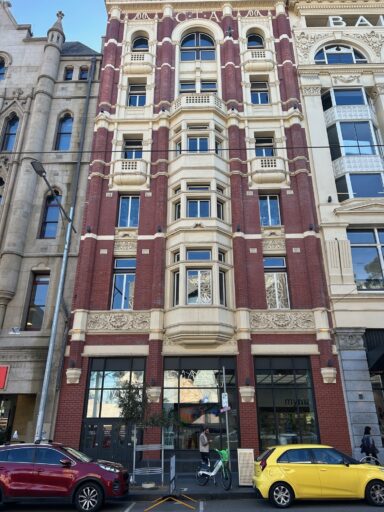
Nine days after the welcome home party at the Overseas Club the venue was used again, this time for a meeting the soldiers had organised themselves.
According to the minutes of that meeting the first order of business was the election of Staff Sergeant Thomas Norman Stephens as Chair of the fledgling organisation.
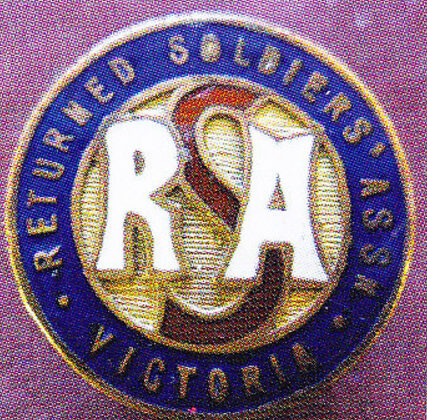
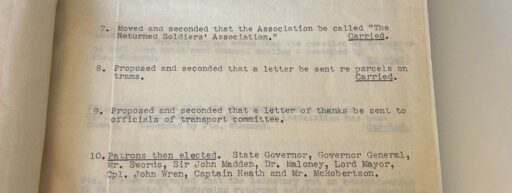
Remarkably Staff Sergeant Stephens was only 20 years old when he enlisted on 15 August 1915, days after the declaration of war. His battalion had been part of the second wave to land at Gallipoli on 25 April 1915. It is not clear the cause but by June 1915 he was found to be medically unfit and returned to Australia. At only 21 years of age, he now found himself the chairperson of Australia’s first veteran charity. The meeting moved the group should be called “The Returned Soldiers’ Association” (RSA) and staff Sergeant Stephens was issued with badge number 1.
Over the following weeks the purpose of the organisation was set out in a series of motions. According to the Argus Chairman Thomas Stephens said that “the association had been formed to look after the interest of returned soldiers generally, to provide a means of social reunion, to lend a helping hand to deserving comrades….and to establish a benevolent fund.”
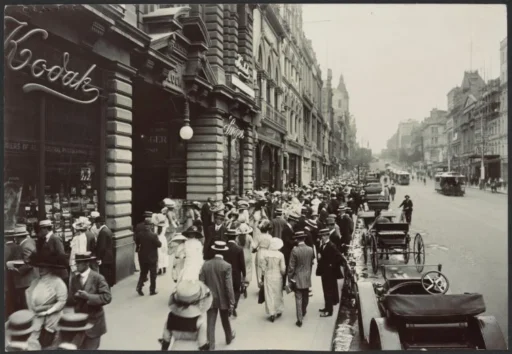
In addition to advocating for free public transport for veterans and discounted theatre tickets, the association directly campaigned for the rights of returned soldiers. In November 1915 they condemned the Richmond City Council for hiring a “strong healthy man” as hall keeper in preference to a returned soldier. They spoke out against impostors wearing military stripes and the cessation of payments of certain allowances to troops serving overseas.
The Association set out to attract donations from wealthy and influential members of the community, making the Governor-General of Australia and Governor of Victoria early patrons with the expectation they would make donations to the associations fund. In November 1915 the RSA began to appeal for donations more broadly, including asking the owner of the winning horse at the Melbourne Cup for a donation.
By January 1916 the committee of the RSA moved a motion that the 25th of April, the anniversary of the landing at Gallipoli, be set aside for the sale of buttons and that “proceeds to be devoted to the Fallen Comrades Memorial Hall.” In March the committee planned the first ANZAC commemoration service with a parade at the MCG and simultaneous services at St. Pauls and St. Patricks Cathedral.
By the winter of 1916 the need for the association grew with each passing battle in Northern France. Soldiers were not only dying by the thousands at Fromelles, Pozieres and elsewhere but those returning with horrific physical and mental injuries had reached unimaginable levels. The government could not cope with the welfare needs of those returning from the front lines or provide for the families left behind.
With the need to provide a unified approach to the repatriation and welfare assistance to returning soldiers a meeting of the state associations was held in the office of the Returned Soldiers Association in The Block Arcade in Collins Street Melbourne on 6 June 1916.
The meeting agreed to create a national association to be called the Returned Sailors and Soldiers Imperial League of Australia and began to write a constitution that set out the purpose of the organisation.
The fundamental principles envisaged by the founders then have not changed with the passing of years. The first three most principles in the original constitution were to:
Maintain a “standard of dignity and honour” amongst servicemen and perpetuate the friendship “created by a mutual service”
Preserve the “memory of those who suffered and died for the nation”
Provide for “the sick, needy and wounded who have served, and their dependents.”
110 years later these principles remain at the core of the RSL’s mission. Through the Veteran and Family Services program RSL Victoria provides support for ADF personnel and their families experiencing physical, psychological, emotional and financial difficulties.
It provides military compensation advocacy to veterans and their families, working to ensure they receive their benefits free of charge.
The RSL’s Strategic Advocacy program seeks to influence government on legislative reform to assist veterans and improve services for them and their families.
The RSL remains at the forefront of commemoration, hosting the annual ANZAC day and Remembrance Day services not only in major cities but at Sub-Branches in regional towns in every part of the country.
The challenges facing veterans remain the same today as they were for the young soldiers who returned to Melbourne to find a society which did not know how to care for those damaged by war. When they needed support, the community offered them trinkets, souvenirs and songs.
Beyond all the support services, the RSL gave the men returning from Gallipoli what they needed most.
A place for veterans to talk to other veterans.
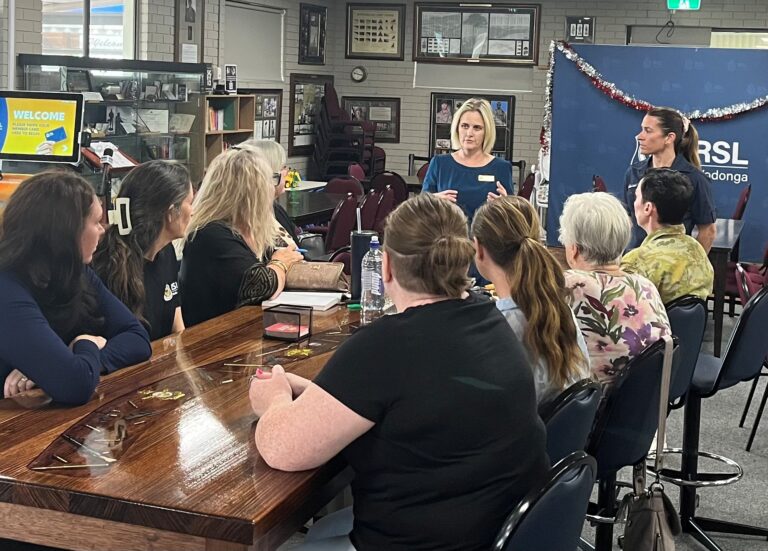
The RSL Sub-Branches have been, and continue to be, critical to fulfilling that most basic of needs.