Medal in the Alley – The remarkable story of Peter Zbardac and his mission to honour a forgotten soldier
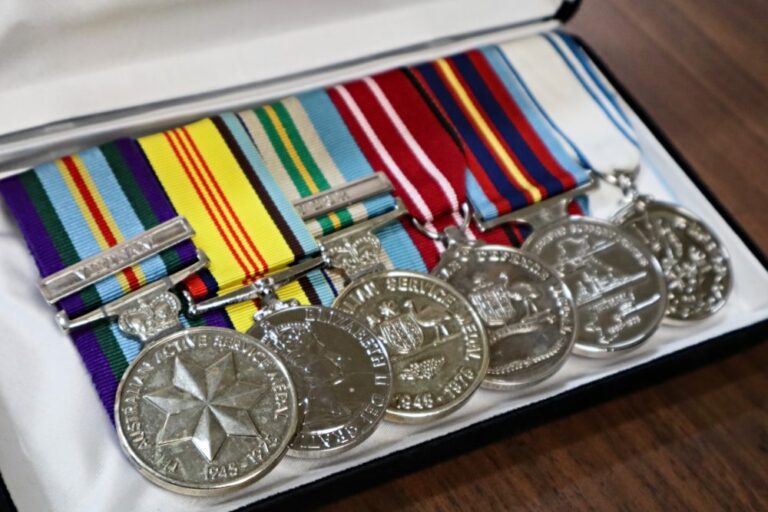
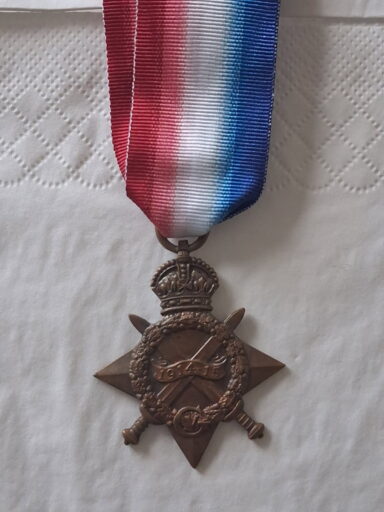
In the early 1970’s Lubo Zabrdac came across a set of medals amongst garbage in a Fitzroy side-street. There was nothing to indicate who the medals belonged to, but Lubo did not like seeing something of such significance thrown out amongst the rubbish.
He took them home and showed them to his primary school aged son Peter.
“I asked who they belong to,” Peter Zabrdac said. “My father didn’t know but he stored them away for safekeeping. I believe his experiences in the Second World war are why he decided to save them.”
Peter’s father was a survivor of the Jasenovac concentration camp set up in the Nazi occupied region of Croatia where around 100,000 people, mainly Serbs, Romani, Jews and Socialists are said to have been killed. Unlike camps such as Auschwitz, where murder occurred on an industrial scale, death was personal and brutal through one-on-one violence using handheld weapons like knives and axes.
“He only told us of the concentration camp shortly before he passed in 2023,” Peter said. “I think the medals meant so much to him because he saw them as mementos of sacrifice that should not be discarded.”
Peter never saw the medals again until he came across the medals while sorting through his father’s belongings shortly after he died. He found them kept secure inside of one of his father’s socks in a drawer.
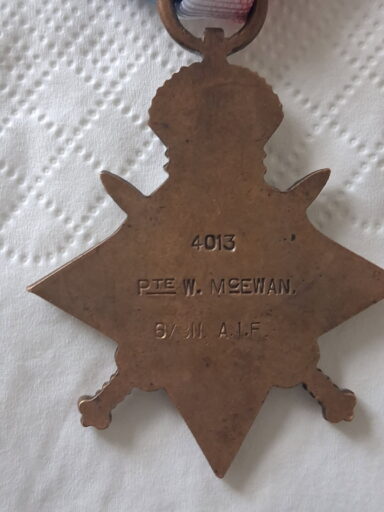
Intrigued, Peter began to research the man behind the medals. The name ‘Pte W. McEwan’ with the service number 4013 written on the back of the medals was his only clue.
Peter googled William McEwan’s name and service number which brought up his service record on the National Archives online database. The record was 79 pages of mostly handwritten files detailing William’s service from enlistment to his return to Australia.
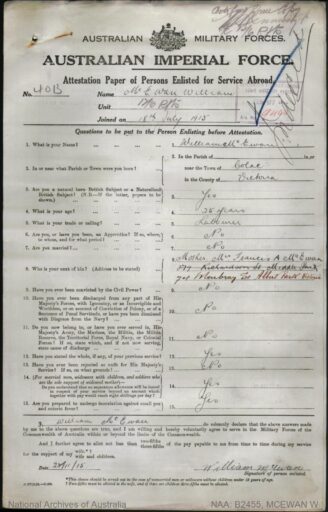
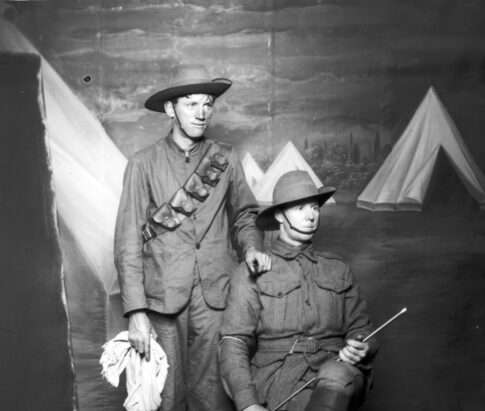
He discovered that Private William McEwan was born in Colac in 1890 and was initially restricted from joining the AIF because of his height (he was only 5 foot 3). With a desperate need for additional troops as the war dragged on, he was finally accepted and, after training in Australia, arrived in Alexandria, Egypt, in March 1916. He was attached to the 6th Battalion who were fresh from Gallipoli, a name already famous in the Australian psyche. They arrived on the Western Front in April 1916 and what awaited them was brutality beyond reckoning at a village called Pozieres where they would die in their thousands.
But William had arrived too late to be with them in their legendary retreat from Gallipoli and would be shot too soon to die with them at Pozieres.
On May 5, 1916, more than two months before the carnage at Pozieres, William was shot through his lungs and both arms.
From May 1916 the rest of the story Peter Zabrdac found in Private McEwan’s files spoke of invalidity and suffering.
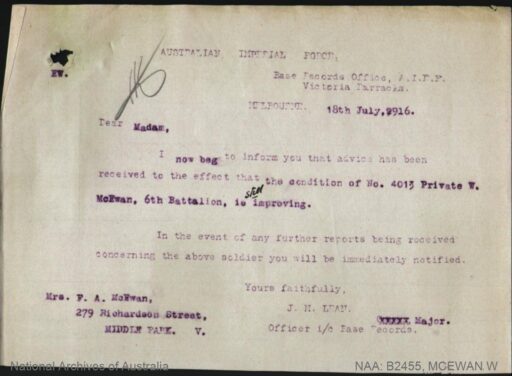
On 18 May 1916 Private McEwan’s mother received a telegram advising that he had been wounded, followed by a further telegram on 6 June that he had been admitted to hospital in London suffering from a severe gunshot wound to the back. On 27 June and then again on 18 July news arrived that his condition was improving.
But his medical records told a different story. On 30 June 1916 he was at the Australian Auxiliary Hospital where he was listed as disabled with the cause being “Gun shot wound chest, both shoulders. Two fragments entered back one on each side. There was considerable loss of breath, blood, spitting. Now some considerable shortness of breath, cough and pains in chest.”
He was discharged in January 1917 after being found permanently unfit for active service.
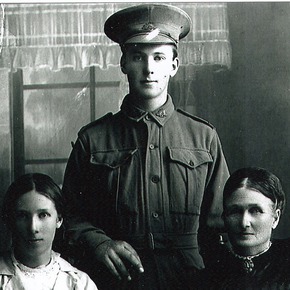
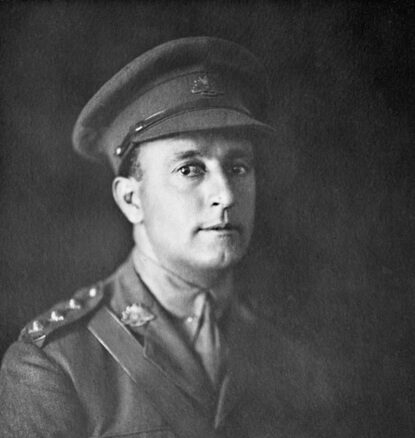
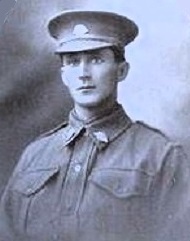
Further online searching by Peter found a photo of Private McEwan on the Virtual War Memorial (VWM) website and he contacted a volunteer from VWM, Faithe Jones, for more information. Faithe was able to locate Private McEwan’s grave in Brighton cemetery and put Peter in touch with Lois Comeadow from the Brighton Crematorium’s group who help preserve the memory of those buried at the cemetery.
Meanwhile Faithe Jones began searching for any other information she could find about Private McEwan. She knew the date of his death from his burial records so began trawling through old newspapers looking for anything that might explain how he had died.
The most startling discovery came in the form of a newspaper article in the Argus newspaper in Melbourne on 6 November 1923.
Under the headline “Pint of Poison” it told how William McEwan “Walked into the bar of a hotel on Brunswick Street, Fitzroy, on October 30, and said to the barman ‘Give me a pint of poison and lend me a bob.’”
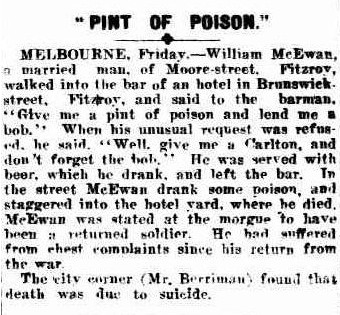
When he was refused the poison William left the bar and the Argus reported that “In the street McEwan drank some poison, and staggered into the hotel yard, where he died.”
The Argus also noted he was a returned soldier who had suffered from chest complaints since the war. The coroner found the death was due to suicide.
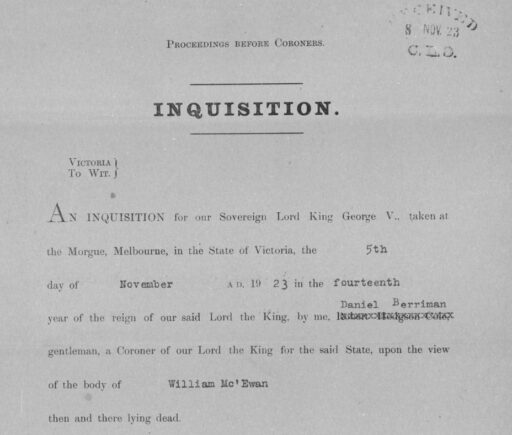
William McEwan was buried in an unmarked grave, with nothing to indicate who he was. Peter was determined to continue the work his father started and ensure William was given a military headstone acknowledging his service.
Peter enlisted the help of his friend Ange Kenos from the RSL state executive who directed him to Mal Carlson from RSL Victoria’s War Graves Working Group.
“We believed his death was directly related to his military service. It was suicide because of depression caused by his injuries and war experiences,” said Mal Carlson. “But we needed to provide evidence to the War Graves office to show a direct connection between his death and war injuries for him to qualify for a ceremonially engraved war service headstone.”
The key piece of evidence was in a coroner’s report in the Victorian State Archives found by Lois Comeadow. The coroner detailed an interview between police and Private McEwan’s landlady.
“She said, almost as an aside, that he suffered terribly because of his breathing problems” Mal Carlson said. “It was the final link we needed to prove he committed suicide because of his service.”
Mal Carlson submitted the evidence to the Officer of Australian War Graves who approved the ceremonial headstone, worth around $7000. However, the headstone could only be added with the approval of the owner of the grave, but no-one knew who that was.
Peter Zabrdac looked for relations of William McEwan through online ancestry sites and found his great niece, Wendy Newman, who now lives in Queensland.
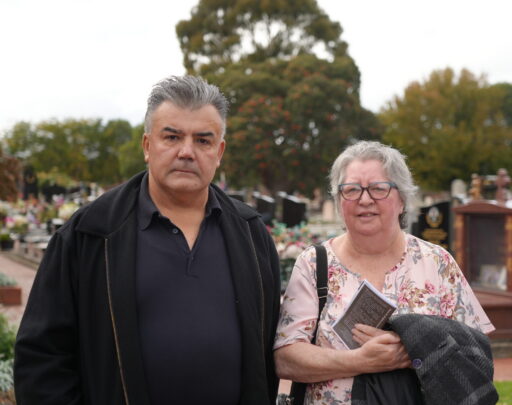
Peter called her and told her the story or her great uncle, but she knew little about him and did not know how his medals had come to be left amongst rubbish in Fitzroy. When it was proven that she was the next of kin Brighton Cemetery assigned her ownership of the gravesite, and she gave the War Graves Office approval for the headstone to be placed on her great uncle’s grave.
“Peter has done an amazing amount of work,” Wendy Newman said. “I am so grateful to him for the work he did in piecing the story of my great uncle together and getting him the recognition he deserved.”
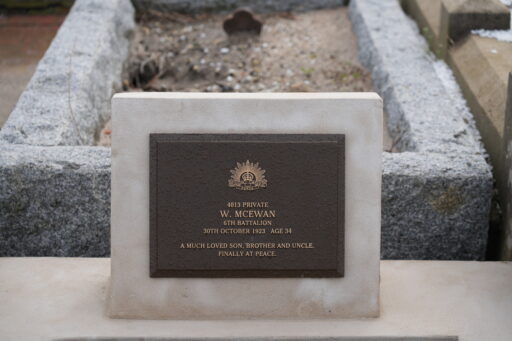
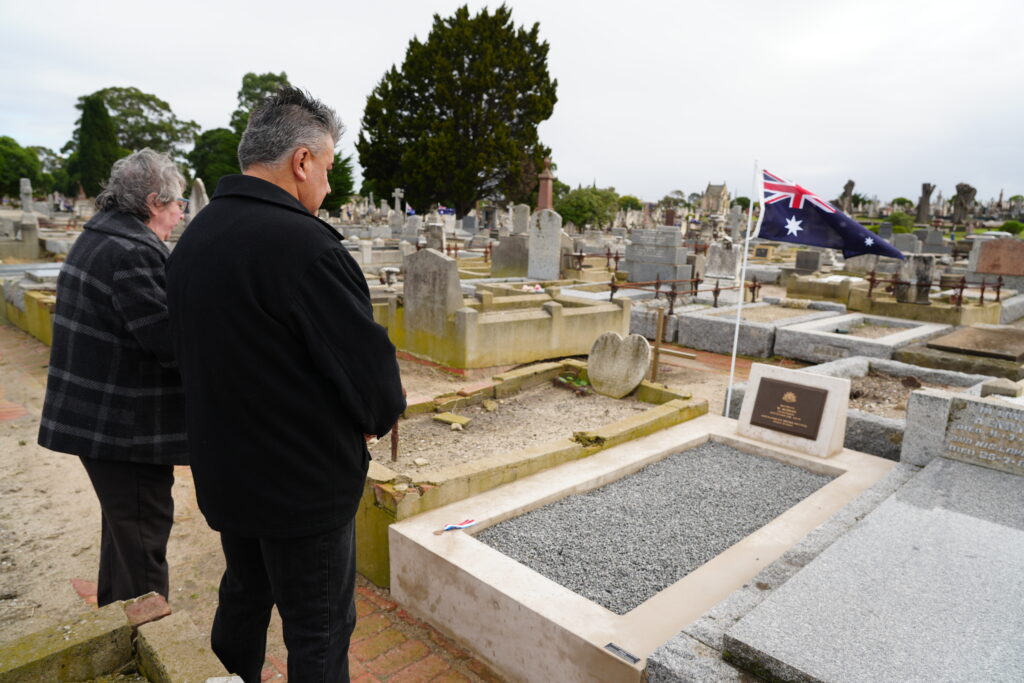
In March 2026 the war service plaque was added to the grave of Private McEwan, providing him the recognition he was denied for over a century.
But the fuel crisis sparked by the war in Iran made the cost of driving to Melbourne from Outback Queensland prohibitively expensive for Wendy and she had to tell Peter that she would not be able to visit the grave.
After years of overcoming every obstacle placed in his path Peter was determined to get Wendy to Melbourne to visit her relative’s grave. He appealed to local RSL Sub-Branches and Epping, Reservoir and St. Kilda Sub-Branches all donated money to pay for her travel and accommodation costs while Peter donated money from his own business.
On 17 April 2026 Peter Zabrdac and Wendy Newman attended Brighton Cemetery where the Brighton Crematorium’s were holding their annual ANZAC Day service. The group pays tribute to all the men and women who served their country in the defence forces in the week leading up to ANZAC Day and Remembrance Day by flying flags over their graves, adding a further 50 flags at each service. There are now 500 flags flying over veterans’ graves at the sprawling inner Melbourne cemetery.
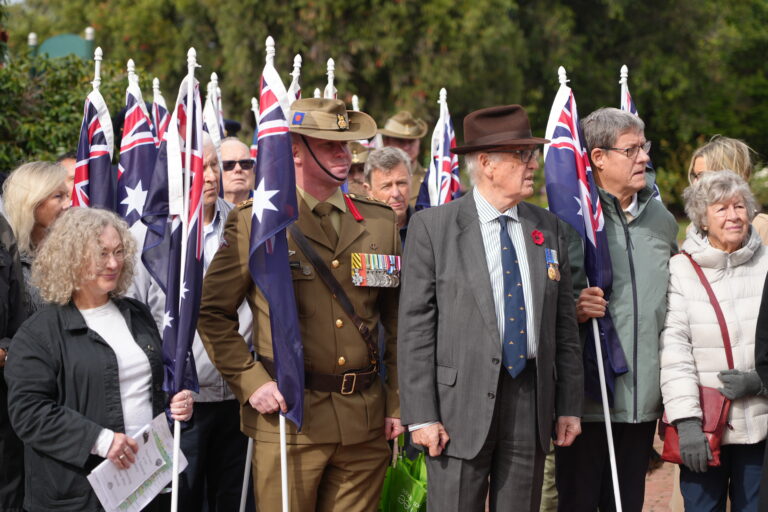
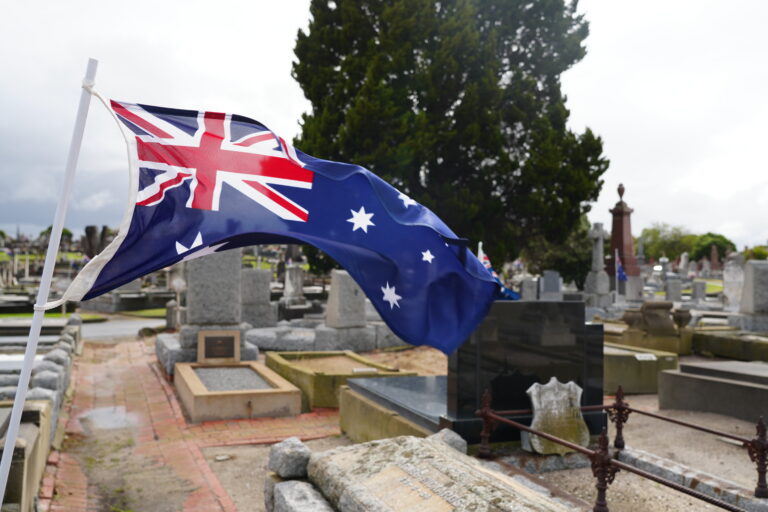
To begin the service this year Peter Zabrdac told the assembled crowd about his journey to trace the story of Private William McEwan. He finished his speech by presenting Private McEwan’s war medal to Wendy Newman, his closest living relative.
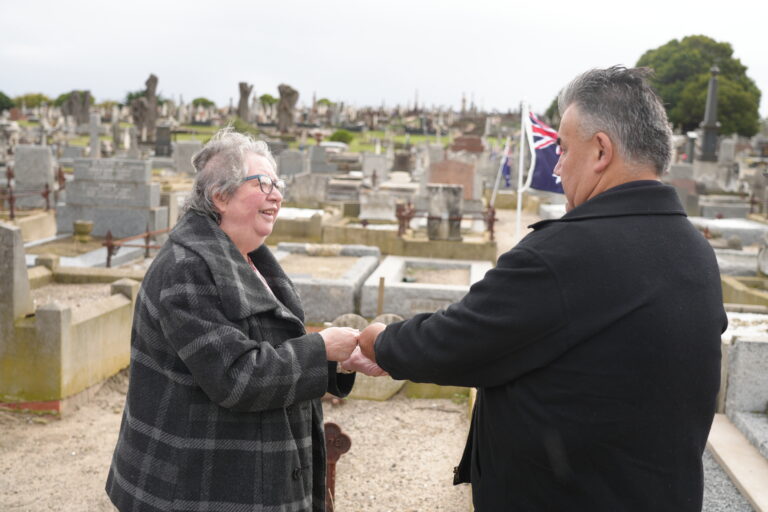
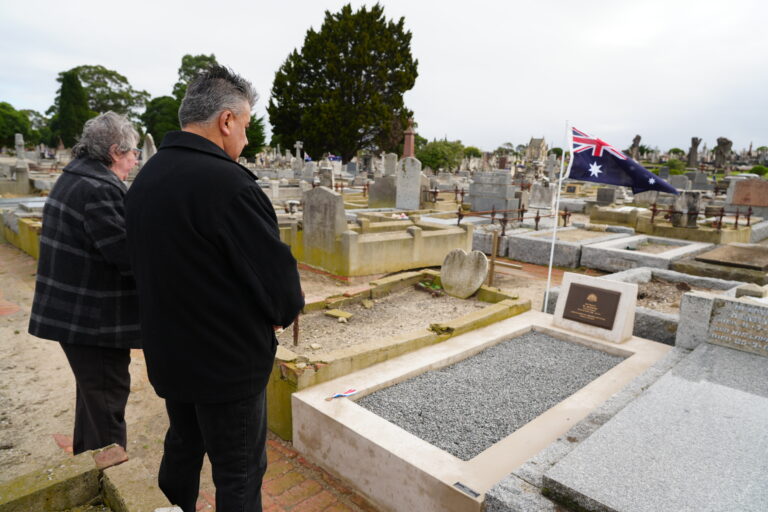
A journey that began more than 50 years earlier amongst the garbage of a Fitzroy street was finally over as Wendy Newman lay the First World War medal of Private William McEwan across his gravestone, in front of the plaque that finally bore his name and honoured his service.