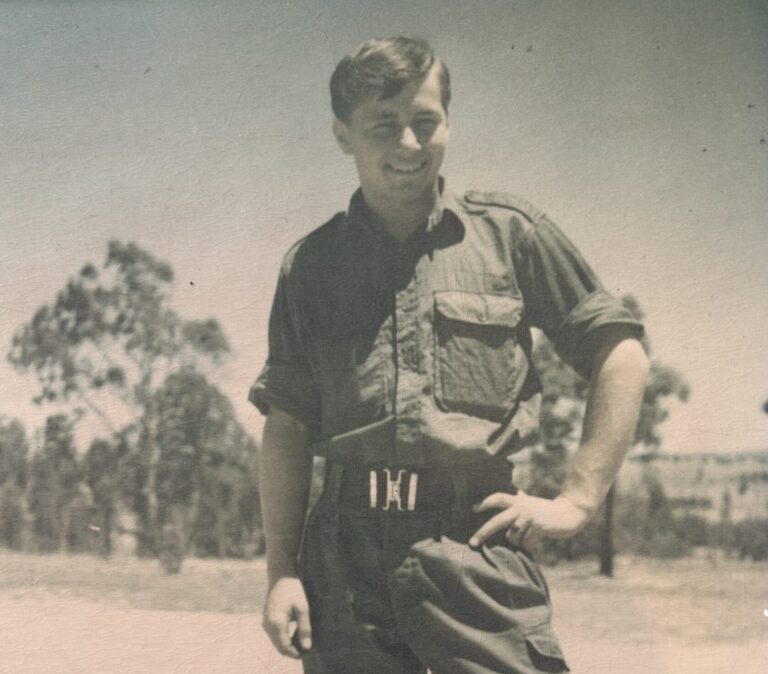
Second World War Veteran George Runting was 19 on the first Victory Day

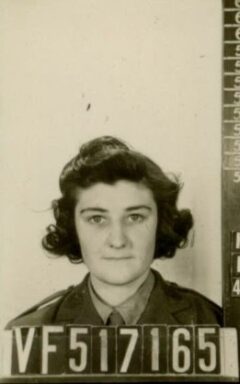
George Runting was born in Maldon in 1925, the child of a First World War soldier who continued to suffer terribly from being the victim of a gas attack on the Western Front.
When he was only three years old his father succumbed to his war injuries, leaving him, his mother and older brother destitute. George credits the generosity of Legacy, an organisation that, like the RSL, was born out of the First World War to care for the families of fallen veterans.
“If it wasn’t for Legacy we would not have made it,” George said. “They would come around every week and make sure we were OK.”
Despite the assistance life was never easy for his family and George, his mother and brother still depending on him for money from an early age.
He was working for the Vacuum Oil company during the early years of the war, while also a cadet with the Number 21 squadron Citizen Air Force through Melbourne University.
He enlisted only days after turning 18 and underwent basic training in Shepparton where he chose to join the radar units and transferred to the Radar school in Richmond New South Wales, before transferring to Cape Otway for more training in late 1943.
He formed up with 302 Radar Station – Mobile air warning in April 1944 and was deployed to Darwin.
“We had a busy time,” George said. “I was at Sattler air base and were covering radar for Spitfires, Beaufort and Mitchell bombers operating out of Darwin.”
By 1945 the Japanese army was in retreat and George was deployed to Morotai in the wake of the allies retaking the island from the Japanese.
“Being in the American zone meant that as Australians we had little to do, it was like being in a tropical paradise,” George said.
George’s time in paradise came to an end in June 1945 as Australia was given responsibility for the invasion at Balikpapan in Borneo.
“One day we had to pack up our equipment on to LST’s (Landing Ship Tanks) and suddenly we went to sea only half loaded. We travelled north for two days not really knowing what was going on when we formed up in a convoy of LST’s all heading south.”
George believes the move was a decoy, designed to deceive the Japanese about the convoy’s real plans.
“We turned around and went back to Morotai,” George said. “We picked up the rest of our equipment and departed for our real target of Balikpapan.”
Balikpapan, in Borneo, was a former Dutch colony that had been captured by the Japanese in early 1942 and contained important oil production facilities. The strategic importance of the invasion at Balikpapan was doubted by Australian commander but United States General McArthur lay responsibility for retaking Borneo on the Australians. The aim was to secure its oilfields and establish a base from which to retake Java.
George’s ship was among 100 US and Australian ships that arrived at Balikpapan on 1 July 1945. His ship at first remained behind the HMAS Shropshire, as it shelled the beach as cover for troops, before moving forward and deployed its pontoons as a beachhead was formed.
George and his radar unit went ashore around dusk and were ordered forward by Army commanders to set up their radar station by an oil refinery.
“The hill near where we set up has become a military cemetery, where the Australians killed that day are buried,” George said.
The army commanders told us to form up our trucks in hollow squares,” George said. “They told us we would be quite safe.”
After two days George’s team had fully set up and had their radar station running.
“At 7 o’clock, two hours after we set up, we picked up an enemy bomber 100 miles away heading towards our bases. We were able to give our air defences half an hour warning of the incoming enemy plane.”
George was at Balikpapan for the rest of the war, as the Japanese were pushed back further inland. George remembers the day they heard the war had ended.
“There were two radar operators on at all times and a wireless operator,” George said. “I was fifteen days off my twentieth birthday. I wasn’t on duty but one of the operators came out and said, ‘Japan has chucked it.”
While the war ending was a relief and George remembers thinking “Thank God,” there were no celebrations on his small radar station.
“We could see flares going off, on the other side of the hill, where the troops were,” George said. “There were celebrations on the bases, but we were a small station. We just kept on working.”
What struck George the most about the end of the war was the way the change that came over the whole country in only a single day.
“I don’t think the locals had a good time under the Japanese. They loved the Australians. When the Dutch came back and tried to take back the country they were not very popular, a few shots were fired at them.”
At 99, and only days short of his 100th birthday, George continues to take a keen interest in the people of Indonesia for whom he developed a deep affection during his time in Borneo.
“Anthony Albanese went straight to Indonesia when he was elected again,” George said. “Indonesia is very important to Australia’s future.”