Major Olive Dorothy “Dot” Paschke – Second World War
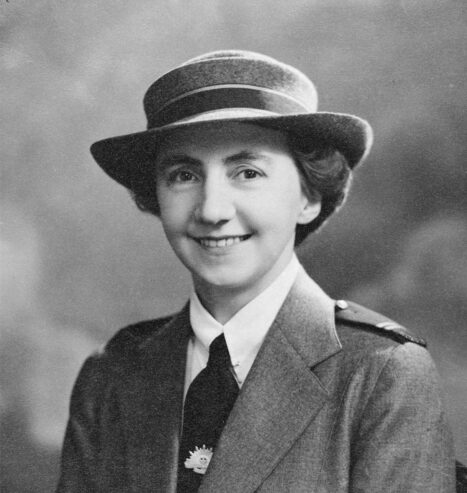
RSL Victoria remembers the sacrifice of Major Olive Dorothy “Dot” Paschke who lost her life serving her country during the Second World War.
Dot was born in Dimboola in the Wimmera region of Victoria on 19 July 1905 the third of five girls born to Heinrich and Ottilie Paschke. Her father was a stock and station agent and the family lived on a property just outside town.
Dot and her sisters attended Dimboola State School and Dimboola High School and were a well-respected part of the local community, her father President of the Agricultural Society and the family prominent in the Presbyterian church. For her part Dot proved herself to be an excellent tennis and golf player.
Dot stayed on her parents’ farm, helping with the farm work, until she was 25 years of age when she travelled to Melbourne to study nursing at Queen Victoria Hospital, becoming a qualified nurse and midwife in 1934. She returned to her hometown and became the matron of Airlie Private hospital which had opened in 1931.
Her father passed away, aged 70, in the Airlie Private Hospital under Olive’s care. Following his death her mother, Ottilie, decided to move to Stawell while Dot returned to Melbourne and became assistant Matron of the Jessie McPherson Hospital, a private hospital attached to the Queen Victoria Hospital where she had trained. Amongst the nurses working under her was Vivian Bullwinkel who would go on to be the most famous of all Australia’s nurses.
With the outbreak of the Second World War, and the desperate need for qualified nurses, Dot’s left the Jessie McPherson Hospital and enlisted in the Australian Army Nursing Service in September 1940.
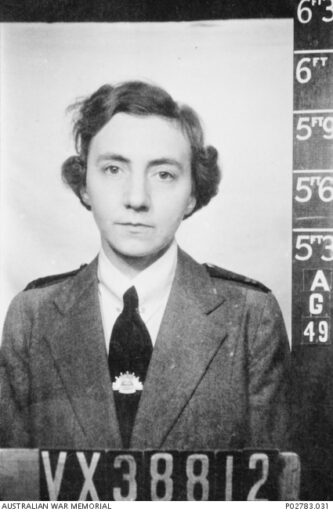
In January 1941 she was detached to the 10th Australian General Hospital (10AGH) and embarked for service overseas in February 1941. The 10 AGH was established at Malacca in what was then called Malaya, and she served as Matron throughout 1941 in support of Australian and Indian troops who were stationed there as the threat of war with Japan loomed ever present.
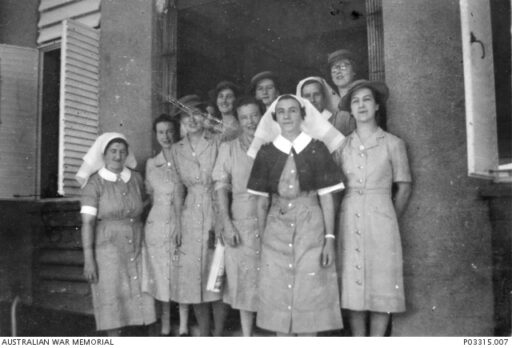
The nurses were kept busy dealing with tropical diseases when a journalist from the Australian Women’s Weekly visited them in April 1941. She told the journalist that many of the local residents treated her and the other nurses like film stars and sent them baskets of fruit and orchids.
In October 1941 the Commander of the 8th Division, Henry Gordon Bennett, singled Olive out for commendation on her service to the hospital writing that “Matron Paschke has, by her enthusiasm and her unfailing attention to duty, given exceptionally good service to the AIF in Malaya…..She, with her nursing staff, facilitated the establishment of a hospital and provided the necessary comfort for the patients. Her unflagging zeal and cheerfulness and long hours of duty have been an inspiration to the nursing staff and have been particularly valuable under the difficult conditions of the tropics.”
Those conditions would become much worse less than two months later when Japan entered the war and began to sweep through Malaya.
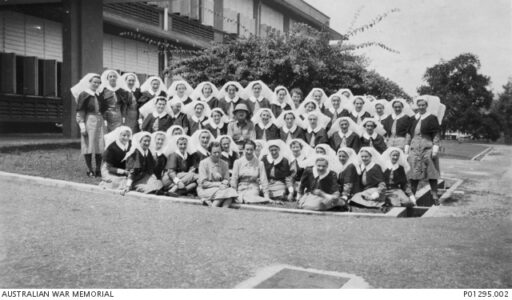
The 10th AGH was evacuated to Singapore in January 1942 and Major Paschke established a 200-bed hospital in a Methodist boarding school, Oldham Hall. She was awarded the Royal Red Cross 1st Class on 10 January 1942.
As the Japanese neared the island the casualties mounted and the 200-bed hospital was dealing with as many as 600 casualties by the end of the month. By early February shells began landing near the hospital, killing staff members and on the 8 February the Japanese began crossing the Johor Strait and landing on the island itself.
On 12 February Dot had to make the heart-breaking decision to order the 65 remaining nurses who had not been evacuated to leave the hospital and abandon the approximately 1000 patients being cared for there.
Under aerial attack they made their way to the harbour where the SS Vyner Brooke waited for them. Nurse Betty Jeffrey would later write that the city was ablaze as they departed on the ship as hundreds of people lined the wharf desperate to get away.
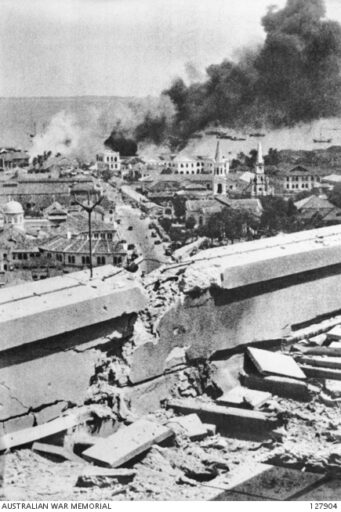
The ship came under air attack in the Bangka strait on 14 February 1942. After being strafed by machine gun fire a bomb struck the ship, and it began to sink. Still in charge of her nurses she ordered them to wait until all civilians had been put on lifeboats before telling them to save themselves.
Despite her skill as an athlete Dot Paschke could not swim. However, she and six other nurses managed to get onto a life raft with some other civilians while dozens of other nurses jumped into the water and attempted to swim to safety or find some other away to make it to shore.
Those on the raft with Dot drifted for many hours until two nurses and some civilians jumped into the water. They had hoped to make the raft lighter to make it easier to reach Bangka Island. Instead, the raft drifted away from the swimmers and was swept out to sea. Neither Dot nor any of the nurses on the raft were ever seen again. Only one nurse who had jumped off the raft, Sister Betty Jeffrey, managed to reach shore. Betty would become a Prisoner of War but finally make it back to Australia when the war ended where she told the story of Dot’s final hours.
Of the 65 nurses on board the SS Vyner Brooke who made it to shore 21 were murdered by Japanese soldiers on Bangka Island and 32 become Prisoners of War, of whom 8 would die in prison camps.
The life of Major Olive Paschke has been remembered long after her passing. In her hometown of Dimboola, a sundial was built in her memory at the school she attended, and her story told is told every year on ANZAC Day by a student, keeping her memory alive for each passing generation.
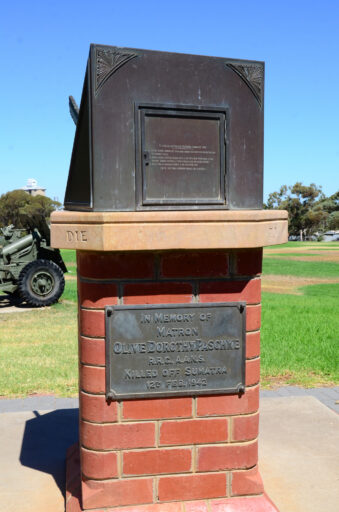
In 1951 she was recognised for her service when she was awarded the highest international medal for nurses, the Florence Nightingale Medal.
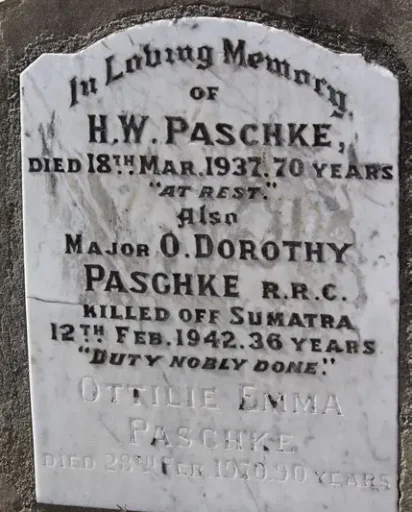
Dot’s mother, Otillie, died in 1970 aged 90 and was buried at Cheltenham Cemetery with her husband Heinrich. Though Dot’s body was never recovered her name was added to tombstone above her parents’ grave.
RSL Victoria pays tribute to Major Olive Dorothy Paschke, her family and all those who have sacrificed in the service of their country.
Lest We Forget.