Mentioned in Despatches – the Victory Day Lyall Butling can never forget

Lyall Butling was only 17 years old and just starting an apprenticeship as a plumber when the Second World War broke out.
“I tried to enlist, but they chucked me out because of my age,” Lyall said with a laugh. “But a friend of mine told me we could join the Scottish Regiment.”
The Scottish Regiment was a militia unit and Lyall was able to serve in garrison duties at Balcombe Military camp before the government integrated him into the 7th Infantry Battalion in 1941. He soon found himself on route to Darwin as the Japanese entered the war.
“We arrived in Darwin on the first day the Japanese bombed it,” Lyall said. “People were rushing out of the city as we were rushing in. It was dreadful. People were dying and Navy ships were being bombed. They were dropping splitter bombs that shot out instead of exploded. If you did not drop to the ground, you had your head cut off.”
Lyall said there was a great fear of invasion from the Japanese in the wake of the fall of Singapore. “Around the coast was all marked out and were doing patrols along the rivers and among the mangroves to make sure there was no enemy sneaking in on the boats.”
Lyall stayed in Darwin for two years, living through repeated Japanese air raids and the constant fear of invasion.
“We were brought back to Melbourne after two years and on the first leave that we had we were supposed to have fortnights leave but we did not get it. We had MP’s knocking on our door telling us to report back to camp.”
Because his battalion had jungle like experience patrolling the mangroves around Darwin the 7th Battalion was sent to the Solomon Islands as the allies attempted to force the Japanese back through 1943 and 1944.
The battalion supported US operations and undertook surveillance of surrounding islands occupied by the Japanese.
“Then we were transferred over to Bougainville,” Lyall said.
By April 1945, with the war in Europe in its final days and Japan’s position increasingly hopeless in the Pacific, the allies planned to drive the Japanese out of Bougainville.
“Our orders, together with the 8th Battalion and the 27th Battalion was to push the Japanese back into the sea,” Lyall said.
This meant traversing the Numa Numa track through steep mountain ranges of Bougainville.
“Numa Numa was like the Kokoda track,’ Lyall said. “Only it had everything. The mountains were so steep, like you have never seen in your life. It was so steep you could not take all your pack with you. You would go up one mountain and then it would go down into a big gully like a saddle and then up another one. There was nothing but hills. The rivers were only about a foot deep but so fast if you stepped in them, you were at risk of being washed away.”
Over the following months the Australian forces pushed forward up the Numa Numa track, in constant fear of ambush from the Japanese.
“They had a habit of hiding and they would catch us by surprise,’ Lyall said. “A few of us got behind enemy lines, we left our sigs hidden in place with a native guide. Somehow some of them got in behind our lines with a woodpecker, a machine gun, and caused havoc. They killed our guard and wounded the sigs and took off. We created a bit of havoc behind their line and came back and got them. We settled the score there.”
On August 13, after the bombing of Hiroshima and Nagasaki, and as their Emperor prepared to agree to unconditional surrender, the Japanese on Bougainville were preparing for a final stand.
More than 2000 Japanese were at the end of the track, coming under bombardment from the Canadian air force before the Australians attacked. Lyall’s rifle was struck by a bullet which shattered into his legs and arm, and he was evacuated back to the RAP (Regimental Aid Post) to recuperate. He was preparing to return to the front on 15 August when his sergeant told him the war was over, the Japanese had surrendered.
“They said you are not going back; you are going home. It was hard to realise that it was over. And then I went to joy…I was going home.”
Lyall returned to Melbourne and made his own way home by tram to his mother in Cambridge Street, Collingwood.
“When I got off the tram, I saw the crowd outside of my place and they all started cheering. I threw my bag, and I raced to my mother and had a cuddle with mum, and we all danced around.”
But for Lyall the end of the war brought tragedy which has stayed with him for the rest of his life.
“Two days before the war ended, I lost two of my best mates. They had been with me right through the war. And that always comes back. Always.”
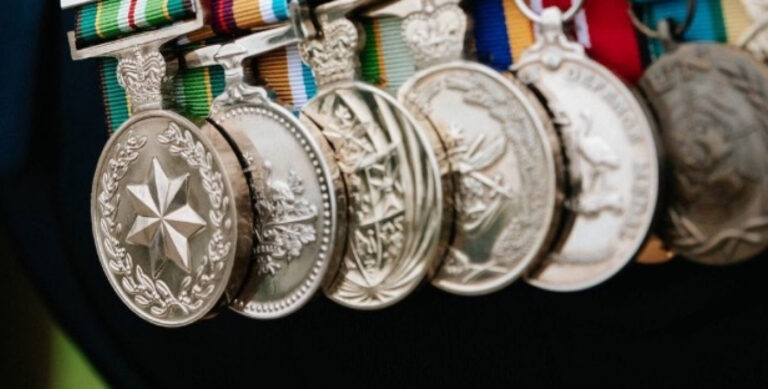
Just over a year after the war ended Lyall received a letter from King George telling him he had been Mentioned in Despatches for his “exceptional service in the field in the South West Pacific” and expressing the His Majesty’s High Appreciation.
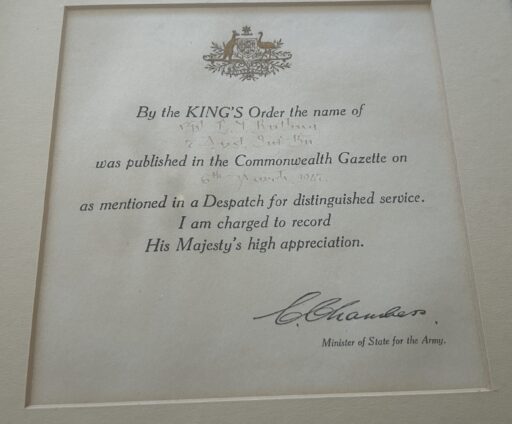
While being Mentioned in Despatches (MID) is a high honour achieved by very few, Lyall is typically modest about his achievement.
“I am not even sure what the MID was for,” he said.
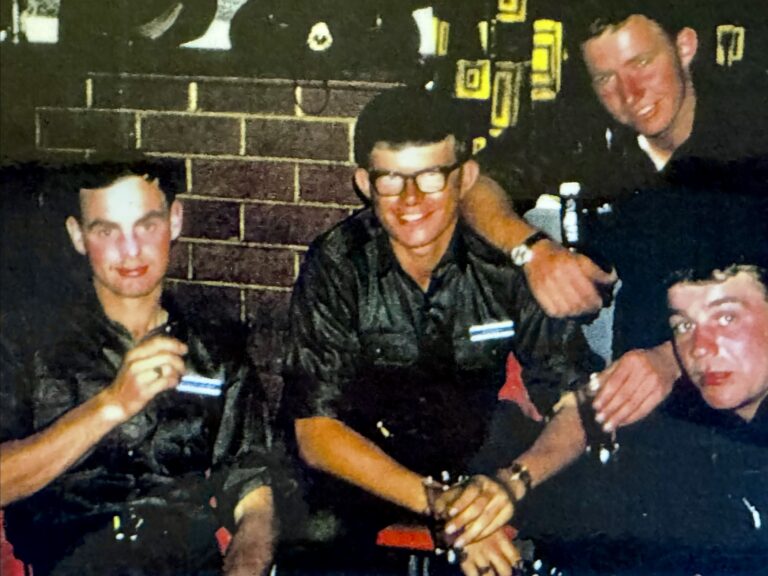
Lyall was to become a founding member of the 7th Battalion Association after the war and served on its committee for six decades. He was President from 2001 until he finally retired from the position in 2016 at the age of 92.
“The battalion remained close after the war,” Lyall said. “We were like a family.”