Private Edward Edwards – First World War
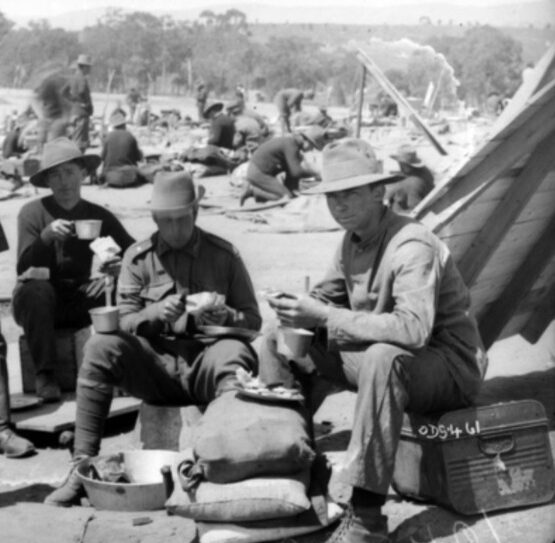
RSL Victoria remembers the sacrifice of Private Edward Edwards who gave his life in service of his country during the First World War.
Edward was born at Wangaratta in July 1897 to parents William Henry Edwards and Alice Edwards nee Phillips. He was the fourth born and third son of their seven children. Edward’s father was a wheelwright in Wangaratta at the time Edward was born. He inherited the blacksmith shop that had been left to his mother’s sister, Harriet Painter nee Hussey, by her husband William when she died in 1900. Instructions in William Painter’s will state it would pass to William Edwards after Harriet’s death. William Edwards was also a councillor on the Wangaratta Borough Council.
Edward attended Wangaratta State School and continued his education at Wangaratta Agricultural High School where he also joined the school Cadet Corps unit. He received a prize during the anniversary celebrations of the Wangaratta Methodist Sunday School in April 1911 for being one of its successful pupils. Later that same year he passed the exam that qualified him for appointment to the Federal Public Service. In 1914, after passing the required exam again, he was appointed to the Auditor-General’s office, Prime Minister’s Office and was required to commence immediately.
Edward’s cousin, Charles ‘Charley’ Powley, enlisted in the Australian Imperial Force on 14 August 1914. He was killed in action with the 7th Battalion during the landing at Gallipoli on 25 April 1915. Avenging his death was one of the reasons Edward gave as to why he should enlist.
Edward was working in the Victorian Postal Department at St Kilda when he turned 18 in July 1915. On 5 August 1915, it was reported in The Yackandandah Times that his mother, who had staunchly refused beforehand, had given permission for both Edward and his older brother Charles to enlist.
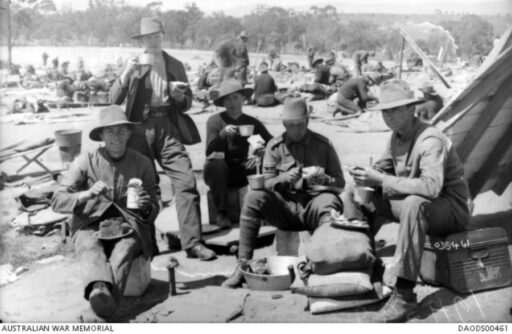
The entirety of the letter that Edward wrote to his father imploring him to understand why he wanted to enlist and his understanding that his departure would be hard on his mother was published with this announcement. In this letter, Edward asserted ‘If I am not allowed to [go to] the war I will never come home again’. Towards the end of the letter he wrote, ‘Somebody must avenge Charley Powley’s death, and it is me for the job’.
Edward and Charles enlisted together in Melbourne on 27 July 1915, receiving the service numbers 3081 and 3082. They both left Melbourne aboard HMAT Commonwealth A73 with the 7th reinforcements of the 24th Battalion on 26 November 1915. Charles and Edward arrived at Suez on 30 December 1915 but did not disembark until 2 January 1916.
Edward was admitted to 1 Australian General Hospital on 16 January 1916 with tonsilitis and remained there for a week. The brothers were transferred to 8th Battalion on 24 February 1916 and joined their new unit in Serapeum for a month of training. They left Serapeum at 9pm on 25 March 1916 to return to Alexandria and sailed for Marseille at 8am the following morning.
After arriving in France, they moved to Steenwerke for more training. The battalion was inspected by General Sir Douglas Haig on 27 April 1916 and commented to the Commanding Officer of the 8th Battalion ‘You have a fine Battalion. I congratulate you. Their handling of arms, steadiness and marching is equal to anything I’ve seen.’
The 8th Battalion moved to Lagnicourt on 1 May and spent time in the support trenches there and at Vauxcourt before spending two days in the Hindenburg Line from 8 May. The remainder of the month was spent at Biefuilliers with parades and more training. The battalion settled into the Messines Sector from 24 June into July.
It was during this time that Edward wrote to his parents with the Wangaratta Chronicle reporting on 9 August 1916 that he had received socks from home and had been in hospital due to swollen toenails. Of his two weeks in the trenches, he ‘‘had a fair time only for rats, ‘chats’, and mosquitoes. It was great to have a wash followed by a sleep…’’
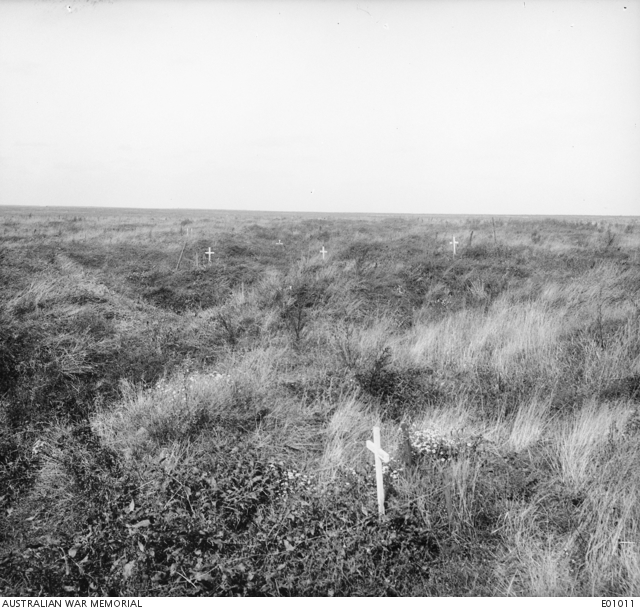
By 20 July 1916, the 8th Battalion were positioned near Albert where they remained until receiving orders to move towards Pozieres on the morning of 23 July. The village of Pozieres was captured by the 1st Division that same day and the 8th Battalion were located to the southwest of the village.
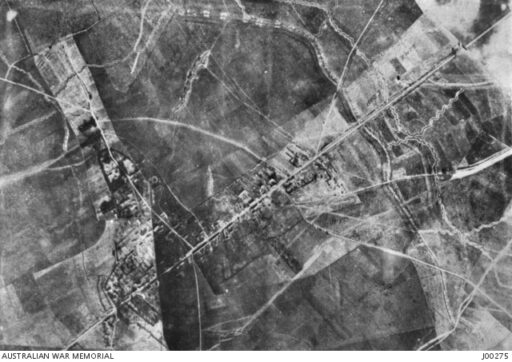
The unit war diary reports that ‘the battalion was constantly under shell fire from enemy guns all day’. By the time the 1st Division moved out on 27 July, it had suffered 5 285 casualties. Edward Edwards was among those who died. His official date of death was 26 July 1916 although there are variances in the date he died recorded in his service record and the date recognised by his family.
Charles Edwards was also wounded at Pozieres and wrote to his parents on 31 July that he was ‘not too bad, although I have had a knock on the head…A piece of shell went through my steel helmet’. He went on to write about Edward’s death ‘I have to tell you that poor Edward was killed on Monday July 24 at Pozieres; he was shot through the head. I did not see him myself. He was following our Captain, who was also killed…But dear mother, he died without pain; have faith that one of your sons may be spared to come back to you.’
Edward’s oldest brother William enlisted in the AIF on 20 May 1917 and along with Charles, returned to Australia after the war. Edward’s father wrote to the Department of Defence requesting the belongings that he knew had been in the possession of his son be returned. These items, a wristlet watch and arm purse, were not recovered with the kit items returned consisting of a scarf, 2 handkerchiefs, cards, a key chain and curios. Permission was granted to Edward’s father by the Assistant Minister to keep the 1914/15 Star issued to Edward in error, as he ‘did not enter a theatre prior to 31 December 1915’. This decision was made after William was interviewed by the police with the reported outcome being ‘He absolutely declines to hand over the medal’.
Edward is recorded on the Villers-Bretonneux Memorial at Villers-Bretonneux, France. He is also mentioned on the Wangaratta Odd Fellows and Borough Council honour rolls. His parents were also presented with a framed certificate on 20 November 1918 acknowledging Edward’s service that ended with the words ‘He gave his Life for his Country’.
RSL Victoria pays tribute to Edward Edwards, his family, and all those who have sacrificed in the service of their country.
Lest we forget.
Written and researched by Theresa Cronk