Sapper Robert Bass – First World War
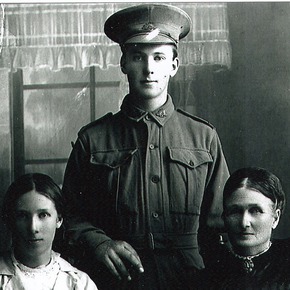
RSL Victoria remembers the sacrifice of Sapper Robert Bass who lost his life after serving his country during the First World War.
Robert was born in Snake Valley just southwest of Ballarat in 1896 to George and Margaret Bass. Robert was the fifth of six children born to his parents, though two had died as infants leaving his elder brothers William and John and a younger sister Margaret.
The town had prospered through the mining boom of the 1850’s and 60’s when his grandfather, a former convict, had moved to the area but the golden days were over by the time Robert was born. The family remained however, continuing to work what remained of the mines.
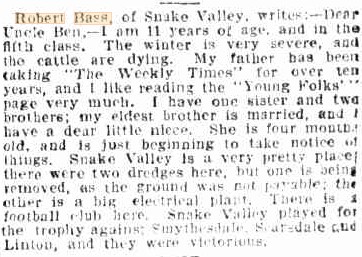
Robert attended school locally and while life on the land as a mining family was difficult, he was surrounded by a loving family. In 1908 Robert provided a glimpse into his family life when he wrote to a children’s page in the Weekly Times called “Young Folks” and his letter was published. His letter read:
“I am 11 years of age and in the fifth class. The winter is very severe and the cattle are dying. My father has been taking “The Weekly Times” for over ten years and I like reading the “Young Folks” page very much. I have one sister and two brothers; my eldest brother is married, and I have a dear little niece. She is four months old and is just beginning to take notice of things. Snake Valley is a very pretty place, there were two dredges here, but is being removed as the ground is not payable, the other is a big electrical plant. There is a football club here. Snake Valley played for the trophy against Smythesdale, Scarsdale and Linton, and they were victorious.”
Prior to the outbreak of the First World War Robert joined the 71st (City of Ballarat) Infantry. On 3 January 1915 his father George wrote a note giving consent for him “to become a volunteer for the Expeditionary force.”
Robert presented the note from his father at the recruitment centre in Geelong on 5 January 1915 and enlisted into the Australian Imperial Force, leaving behind his parents, siblings and fiancé Marguerite Ball.
He initially posted to the 6th Battalion, but with significant experience as a miner, he was transferred to the 2nd Field Company Engineers.
As he completed his training in Australia and later in Egypt, he kept in constant contact by letter with his fiancé and mother, writing to them as soon as he arrived in Gallipoli on 17 June 1915.
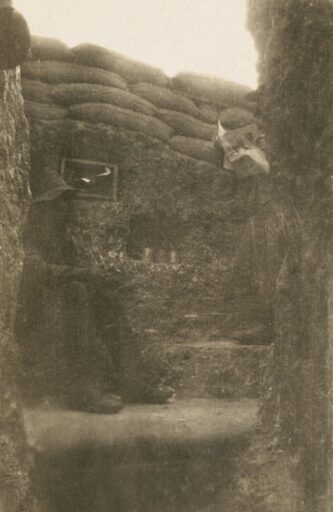
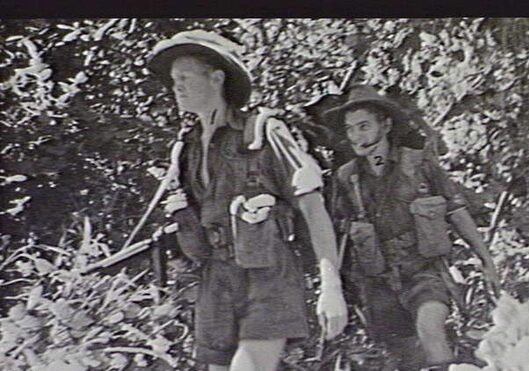
Sappers like Robert Bass were responsible for the construction and excavation of trenches and defensive positions in the notoriously difficult Gallipoli landscape. Despite landing on 25 April, the ANZAC’s had not been able to advance far beyond the beach and were in a state of stalemate when Robert arrived. Over the next six weeks plans were drawn up to break through the Turkish lines in a series of co-ordinated attacks which began with a partially successful attack at Lone Pine.
The next day, 7 August, revealed the true horror of trench warfare with hundreds of the 3rd Light Horse Brigade cut down by machine gun fire as soon as they leapt from the trenches.
The carnage and horrendous loss of life would last throughout the month of April as the ANZAC’s failed to break out. With thousands killed on both sides it is not to be wondered that in the midst of these horrors Sapper Robert Bass disappeared without trace.
The last that was heard from him were letters to his fiancé, Marguerite, and mother, Margaret on 4 August 1915. The letters arrived in early September 1915 and then his family and Marguerite heard nothing more from either him or the Army.
In January 1916, with the Gallipoli campaign over, his mother wrote to the Defence Department. She wrote:
“From an anxious mother to know if you can give me any information about my son Private Robert Bass…..”
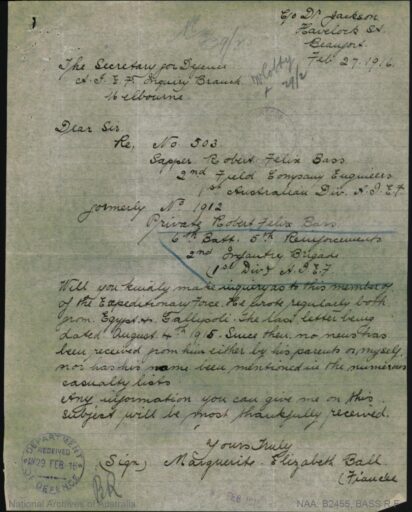
His mother’s plea was followed by a letter from his fiancé, Marguerite, to the Secretary of Defence:
“Will you kindly make inquiry as to this member of the Expeditionary force. He wrote regularly both from Egypt and Gallipoli, the last letter being dated August 4th, 1915. Since then, no news has been received from him either by his parents of myself, nor has his name been mentioned in the numerous casualty lists. Any information you can give me on this subject will be most thankfully received.
Yours Truly,
Marguerite Elizabeth Ball (Fiance)”
In March 1916 the records office responded to his Robert’s fiancé advising that:
“No report to any effect has been received is respect of this soldier. Consequently, it is assumed he is with his unit.”
The family continued to press for any information as to their missing loved one through 1917, eventually appealing to their local Member of Parliament, James Manifold, who wrote to the Defence Department seeking information in September 1917.
The Army conducted an inquiry into his disappearance, which included contacting his family asking for information they might have about his whereabouts. His father responded that they had heard nothing since 4 August 1915 and that “I have several relations at the front but not one of them ever met him or could find out where he is.”
The only reference to Sapper Bass the inquiry could find was a line in his file that said was transferred to hospital on 24 August 1915. Nothing could be found to confirm this entry on his file and no trace of him was found.
The inquiry determined that Sapper Bass had been killed at Gallipoli at some point during the month of August 1915.
On 11 March 1918 the Ballarat Courier finally reported the news that:
“Mr and Mrs George Bass, of Snake Valley, have been notified by the Defence Department that their son, Private Robert Bass, who was previously reported missing, was killed in action at Gallipoli in August 1915.”
He was 19 years old at the time of his death.
RSL Victoria pays tribute to Sapper Bass, his family and all those who have sacrificed in the service of their country.
Lest We Forget.