Private Clarence “Clarrie” Walter Brown – First World War
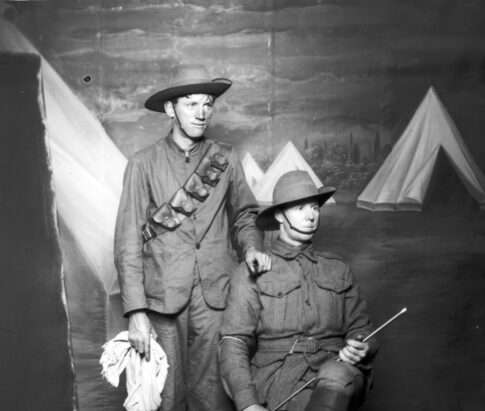
RSL Victoria remembers the sacrifice of Private Clarence “Clarrie” Walter Brown who gave his life in service of his country during the First World War.
Clarence was born as Walter Clarence Brown at Blue Mountain near Trentham, Victoria, in 1898 but was known as Clarence or Clarrie. He was the fifth born and youngest son of the seven children born to Thomas Bertram Brown and Emma Amelia Brown nee Westlake. Clarence’s parents resided in Garlick’s Lead, a mining district at the foot of Blue Mountain (commonly known as Blue Mount) which is in very close proximity to Newbury. In 1922, Ella Luscombe explained the location writing ‘The name of the place is Garlick’s Lead, but our post office is named Newbury’.
Clarence attended Garlick’s Lead State School in a building which had formerly been the Jackson’s Creek State School, near Stawell. This was relocated to Garlick’s Lead after the original school burnt down in 1900. Clarence attended the school after the establishment of the new school building, which came on the heels of an article published anonymously in The Argus by one of the local mothers titled ‘School Children Starving With Cold’, and left before the building burnt down again in 1914.
After leaving school, Clarence worked as a labourer. Prior to enlisting in the Australian Imperial Force in January 1916, under Clarence Walter Brown, he served for periods of three months respectively with 66A Senior Cadets and 66 Battalion, Citizen Forces, in Kyneton. A note on his attestation papers indicates that he had returned his ‘kit’ prior to enlistment and he was the last of his brothers to enlist. His older brother, George Brown, enlisted with the 6th Infantry Battalion on 3 September 1914. His other brothers followed with William John Brown enlisting with 12th Field Artillery on 10 July 1915 and Frederick Brown enlisting on 12 December 1915 with 2nd Tunnelling Company. Clarence enlisted, with the permission of both parents, in Melbourne at the age of 18 years on 11 January 1916.
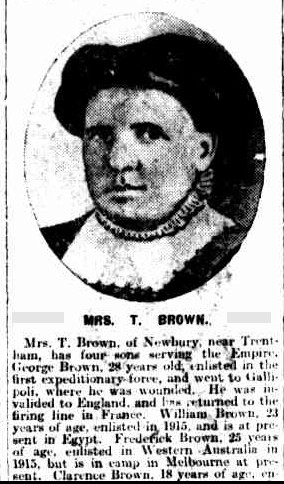
Clarence joined the 24th Battalion from 24 January 1916 at Royal Park until 13 February 1916. He then joined the 21st Depot Battalion at Warnambool from 18 February to 4 March 1916. From 10 March to 19 May, he was assigned to the 16th reinforcements of the 14th Battalion and departed Melbourne with this unit aboard HMAT A68 Anchises on 14 March 1916. He joined the 4th Training Battalion at Tel-el-Kebir, Egypt on 15 April 1916 before transfer to the 46th Battalion on 20 May 1916. He embarked at Alexandria bound for England on 2 June for England aboard Franconia and disembarked at Plymouth on 16 June 1916 where he joined the 12th Training Battalion. Clarence proceeded to France on 25 July 1916 and joined the 46th Battalion at Albert on 16 August 1916. This was the same day that both his brother George died of wounds sustained in the Battle of Pozieres at the age of 29 and an article about Clarence’s mother and her four sons on active service was published in The Argus newspaper.
The unit remained in billets until they moved into the tranches at Albert on 29 August to relieve the 28th Battalion. The war diary records that ‘very heavy rain’ commenced at midday that same day and continued through to the 31 August, with ‘trenches being waist deep in mud and water in many places’. Clarence was not with the battalion when they returned to the front line on 20 September 1916 as he had been admitted to hospital at St Omer with mumps while the battalion was in billets.
Clarence rejoined the 46th Battalion in the front line on 3 October 1916. He was back in hospital approximately a month later with conjunctivitis and rejoined the unit at Dernancourt on 10 November before proceeding back to the front line near Guerdecourt on 12 November 1916. He was wounded in action the following day during a period of ‘very active’ and ‘practically continuous barrage’ of enemy shelling. Clarence sustained a gunshot wound to the toes on his left foot and was sent to England.
Clarence remained in England until 13 March 1917 and was transferred to the 65th Battalion. He rejoined the 46th Battalion in France on 2 June 1917 and was one of 32 other ranks detached for duty with 47th Battalion on 6 June for the Battle of Messines. The Battle of Messines began on 7 June 1917 with the detonation of 19 mines and the 47th Battalion occupied their final objective at 8.39am on 8 June.
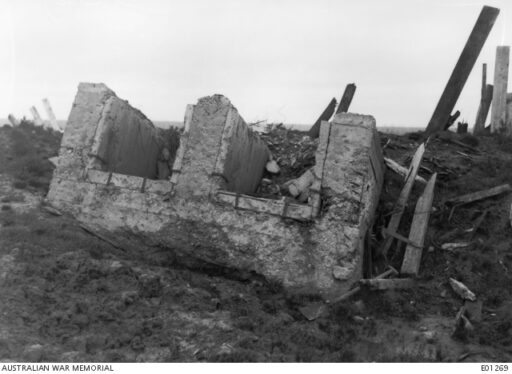
The battalion suffered heavy casualties and had their first experience of pillbox fighting where machine guns housed in concrete shelters forced them to take cover. Clarence was admitted to hospital on 12 June 1917 after being buried by a shell and sustaining severe gunshots to both legs. A witness later reported that Martin, believed to be Sergeant James Lewis Martin, dug him out. Clarence had one leg amputated but died of wounds on 14 June 1917.
On 20 August 1917, Clarence’s mother wrote to Base Records advising that two of her sons had died and one was missing. She finished her letter with this request:
…we have still one boy there. I wish I could get him home now that he is all we have left and we are only two old people..
The Administrative Headquarters of the AIF in London wrote to the Transport Section on 12 December 1917. Arrangements were made for the passage of Driver William John Brown back to Australia where he was discharged for family reasons on 18 March 1918. Frederick Brown also returned to Australia following release from the Limburg POW camp, Germany.

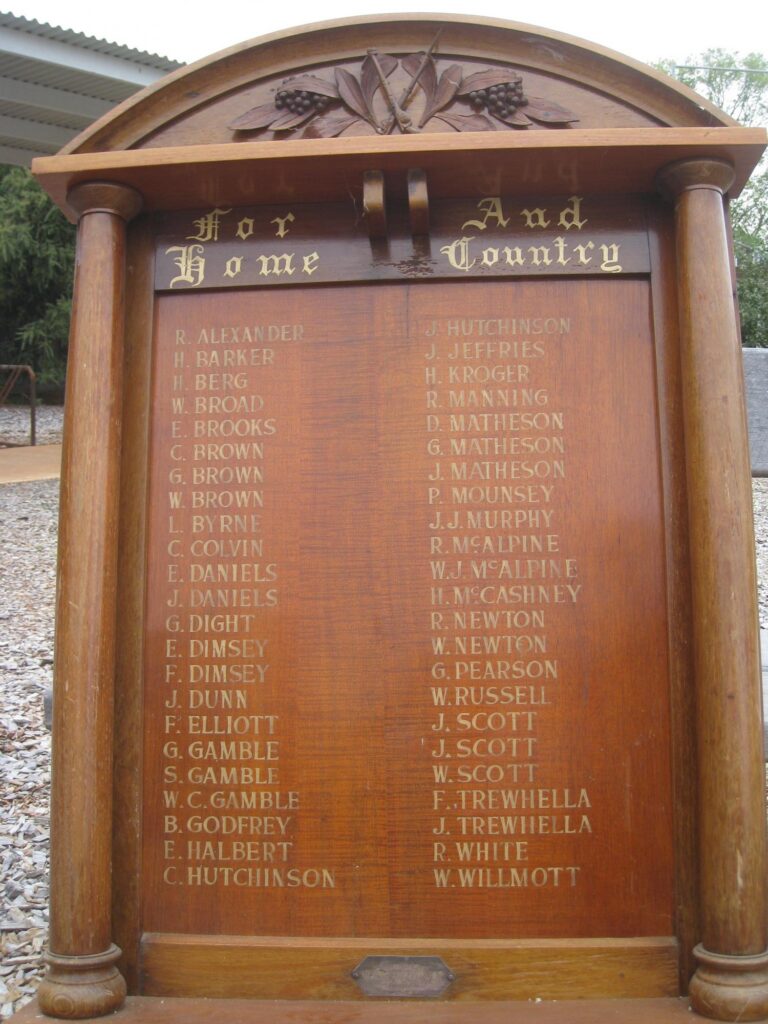
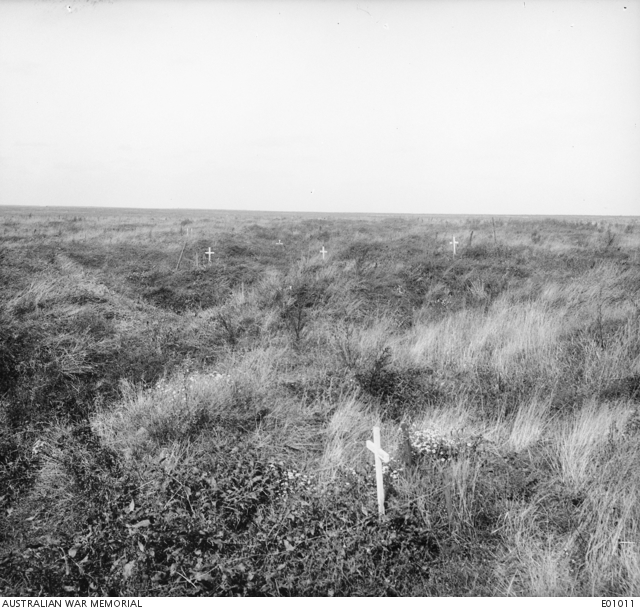
Clarence is buried in the Ballieul Communal Cemetery Extension and is mentioned on both Garlick Lead and Trentham honour rolls and cenotaphs.
RSL Victoria pays tribute to Clarence Walter Brown, his family, and all those who have sacrificed in the service of their country.
Lest we forget.